risk management round

Managing Risk

CMC’s Board oversees the enterprise risk management (ERM) policies and procedures developed by management, with oversight of risks in specific areas assigned to certain Board committees depending on the nature of the risk. The ERM policies and procedures identify and assess various risks facing the company, including environmental risks from the impact of climate change and other issues, which are discussed in Chapter 2.

The ERM process is directed by management’s Executive Risk Committee, made up of members of our executive leadership team and the Management Risk Committee. The Management Risk Committee is jointly chaired by our chief legal officer and director of internal audit with leaders from all critical areas of our business. The Management Risk Committee meets at least twice a year to discuss current and emerging enterprise risks and presents the results from these meetings to the Executive Risk Committee, which is chaired by our chief financial officer. The Executive Risk Committee meets regularly to review the changing risk landscape. This committee provides both an annual risk assessment and periodic updates to the Board and relevant Board committees.
Throughout CMC, we expect our employees to report any known or suspected violations of laws, the Code or other CMC policies. We encourage employees’ efforts with confidential channels such as our ethics hotline, which we make available 24/7. Employees can also report issues in writing or verbally speak to:

  • Their supervisors
  • HR representatives
  • Director of Internal Audit
  • Chair of the Audit Committee
  • Chief Legal Officer

As a sustainability leader in the steel industry, we are focused on meeting the rapidly evolving regulatory requirements for sustainability disclosures mandated by the U.S. Securities and Exchange Commission (SEC) and the EU’s Corporate Sustainability Reporting Directive (CSRD).

The SEC’s proposed rules enhance and standardize climate-related disclosures. By adopting the CSRD, the European Parliament is dramatically overhauling and expanding corporate sustainability reporting, which impacts about 50,000 public and private companies in the EU, including more than 10,000 EU subsidiaries of non-EU companies such as CMC.

Our efforts to manage and report on climate risks include proactively addressing the emerging requirements in Europe and the U.S. To that end, CMC completed a climate risk assessment (CRA) in 2023. We are also working to establish our 2040 and 2050 emission targets to reach net zero by 2050 as part of our commitment to the Global Steel Climate Council (GSCC).

The CRA process, led by a third party, is aligned with the recommendations of the Task Force on Climate-related Financial Disclosures (TCFD), which is globally recognized as best practice. Both physical and transition risks over short-, medium-, and long-term timeframes were assessed for our global operations. The potential impact of each risk was considered, as well as the probability of occurrence and the driver of uncertainty behind the evaluation of each risk.

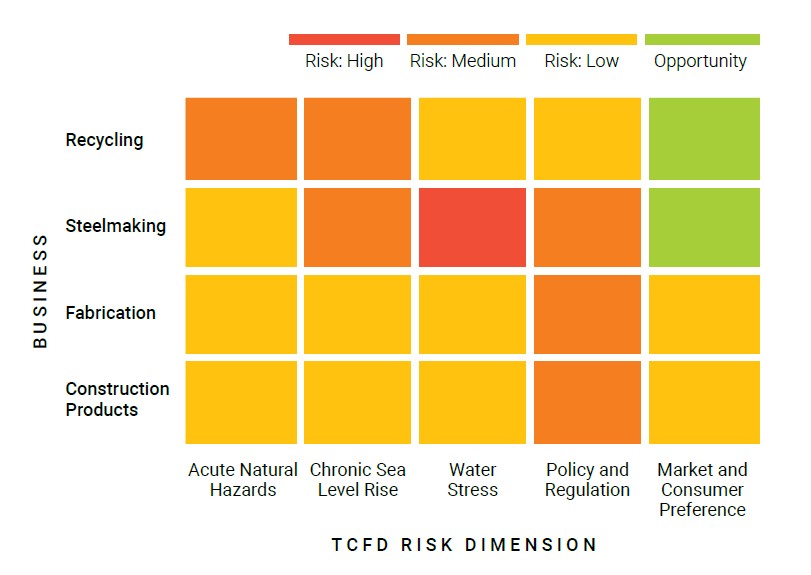
Climate Risk Assessment Matrix

The results of the assessment are displayed in the risk matrix below, which considers the likelihood and impact of CMC’s climate-related risks and identifies opportunities for action.

Overall, the results of the CRA support the need for continuous monitoring of our activities and gathering of data to build best practices for mitigating risks and capitalizing on opportunities. The next steps in this work may include the following:

  • Investigating productivity loss at facility sites due to climate events
  • Tracking carbon pricing for raw materials
  • Engaging critical suppliers
  • Tracking customer requests for sustainability criteria
  • Preparing for upcoming sustainability reporting regulations

CMC's Climate Risk Assessment Matrix. Business units on the y-axis and the TCFD Risk Dimension on the horizontal. A series of colored boxes showing the assessed climate risk.